Monday, December 05, 2005

Pink Stainless Tail

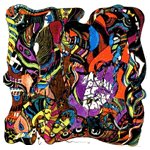
Alongside Thirteen Floor Elevators, Red Krayola were one of the most influential psychedelic acts coming out of Texas in the 1960s. Their debut album Parable of Arable Land, released in 1967, stands out as one of the most psychedelic albums ever released. From the trippy cover art to the avant garde "Free Form Freakouts" that appear between each song, Parable of Arable Land defines psychedelia.

Today's track, culled from Parable of Arable Land, is "Pink Stainless Tail." The song is bookended by, what is referred to on the tracklisting, as "Free Form Freakouts." These 'freakouts' consisted of Red Krayola and fifty of their closest friends performing with everything from typical musical instruments to bottles, rocks, motorcycles, and buzzsaws. These jams may not be for the average music listener, but fans of psychedelic rock are sure to enjoy it.

Although nearly overshadowed by the 'freakouts,' the actual song "Pink Stainless Tail" is quite an enjoyable piece of music. The song goes at a driving pace, with an onslaught of guitars and some very powerful drumming. A listener can get lost in song, especially during the guitar solo. And before you know, the song segues seamlessly into another free form freakout.

Parable of Arable Land is a must for any fan of psychedelic or avant garde rock, and, while I am posting one song from the album, one can't really do the album justice by judging it only on one song. Listening to "Pink Stainless Tail" will give you a taste, but only a full, uninterrupted listening of the album will allow the listener to truly appreciate what Red Krayola achieved with this album.

Red Krayola
"Pink Stainless Tail"
1967

Wednesday, November 23, 2005

The Other Half

Since I've had my fill of Thanksgiving turkey and annoying mall shoppers (the holiday season seems to bring out the stupidity in people), I've decided its about time to return to Medicinal Music. A random maintenance notice: I've been getting some complaints about the downloading speeds @ megaupload.com, if any readers have suggestions of similar uploading sites, please leave them in the comments section, or email me at medicinalmusic@gmail.com

The Other Half was a California based garage/psych band from the mid-1960s. Featuring former members of Sons of Adam, including future Blue Cheer guitarist Randy Holden, the band is best known for their gritty contribution to the famous Nuggets compilation -"Mr. Pharmacist." But instead of covering their not-so-subtle ode to their drug dealer, today Medicinal Music will cover their ode to a girl with long black hair, aptly titled "Girl With The Long Black Hair."

"Girl With The Long Black Hair" owes more to the British r&b bands of the time than the acid drenched California psychedelic scene the band was immersed in. Lead singer Jeff Nowlen approaches the song with less abrasive bravado than "Mr. Pharmacist," instead singing in a subdued, yet assertive tone. Holden peppers the song with electric guitar licks, and the rest of the band fills out the song with some great backing vocals.

The Other Half
"Girl With The Long Black Hair"
1966

Friday, November 18, 2005

Black Monk Time

Five former United States GIs, living in Germany, wearing black robes on stage and sporting tonsures - not exactly what you'd expect would be the recipe for groundbreaking proto-punk music, but The Monks did just that in 1966. Their only album, Black Monk Time, has benefited greatly from hindsight, measuring up to the standards set by other, more mainstream, acts of the time. For fans of 1960s garage/proto-punk rock, Black Monk Time is a must.

Energetic vocals, fuzztone bass, and experiments with guitar feedback are just a few of the things The Monks utilize to create their sound. It sounds like everything else from the mid sixties, yet like nothing like anything from the mid sixties. I know that is a complete contradiction and probably isn't the best way to explain the music, but that's all I got.

I have included a link for "Oh, How To Do Now," a song that highlights Gary Burger's vocals and a rhythm section that steadily chugs along for most of the song, only to pick up the tempo during the outro, which features some cool organ and guitar solos. I know I usually go a bit more indepth about the featured band and song, but The Monks have a fantastic official site that will give you a much better understanding of the band's history. Be sure to check it out.

The Monks
"Oh, How To Do Now"
1966

Thursday, November 17, 2005

Time To Clean Up

Just making a quite maintenance note (there will be a post later today): All of the .mp3 links from the month of September will be removed from the blog at the end of this week (Friday if I'm motivated, Sunday if I'm not). So if you are curious about any of the songs posted in September, download them while you can. I also want to remind everyone that these .mp3 links are for educational/previewing purposes only. If you enjoy what you hear, be sure to support those artists and the record labels that release their material by purchasing the real thing.

Wednesday, November 09, 2005

Let's Roll Another One

After the insanity which was Medicinal Music's last post, I've decided to give my brain a breather and do a little simpler post. So, today, we're going to be covering an unreleased cut by my favorite era of Pink Floyd's history - the Syd Barrett era. I'm sure if you're reading this blog, you are familiar with Piper At The Gates of Dawn and the story of Syd Barrett, but I figure that some people may not have heard this b-side's original version, so here it is.

For Pink Floyd's first single, the band recorded "Arnold Layne," the story of a man with an affinity for stealing woman's clothing from washing lines. The song was much poppier than the material the band would play in concert, leaving some fans to claim the band sold out (which, in hindsight of the band's complete history, seems a bit absurd). But, it is the b-side of "Arnold Layne" that has a bit more interesting history around it.

"Candy And A Currant Bun" was originally "Let's Roll Another One," which, surprise, was a pretty blatant ode to smoking joints. Despite the increasing influence of the drug culture on the mainstream, Pink Floyd's record label, EMI, thought the song was a bit too provocative. To appease the EMI, Barrett reworked some of the lyrics, renaming it "Candy And A Currant Bun." This new recording had a bit slower tempo than the original, and Barrett, obviously unhappy having to amend his work, sneaks in a certain four letter word, which went unnoticed by the record execs. To hear this, pay close attention to "Candy And A Currant Bun" from :25-:30.

If you are interested in learning more about Syd Barrett, his experiences as a member of Pink Floyd and as a solo artist, I recommend Julian Palacios' book "Lost In The Woods." You can find information about the book, as well as read some excerpts, on Palacios' website.

Pink Floyd
"Lets Roll Another One"
1966 (unreleased)


Pink Floyd
"Candy And A Currant Bun"
1967